


Page 16
P. 16
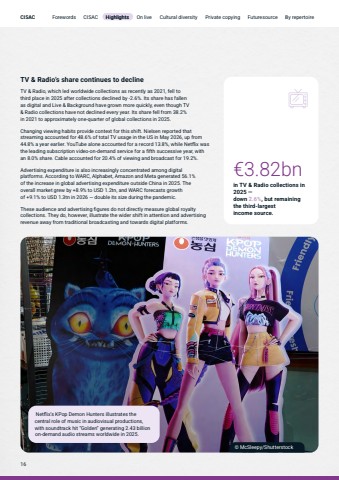
TV & Radio%u2019s share continues to decline%u20ac3.82bnin TV & Radio collections in 2025 %u2014down 2.6%, but remaining the third-largest income source.%u00a9 McSleepy/ShutterstockNetflix%u2019s KPop Demon Hunters illustrates the central role of music in audiovisual productions, with soundtrack hit %u201cGolden%u201d generating 2.43 billion on-demand audio streams worldwide in 2025.TV & Radio, which led worldwide collections as recently as 2021, fell to third place in 2025 after collections declined by -2.6%. Its share has fallen as digital and Live & Background have grown more quickly, even though TV & Radio collections have not declined every year. Its share fell from 38.2% in 2021 to approximately one-quarter of global collections in 2025.Changing viewing habits provide context for this shift. Nielsen reported that streaming accounted for 48.6% of total TV usage in the US in May 2026, up from 44.8% a year earlier. YouTube alone accounted for a record 13.8%, while Netflix was the leading subscription video-on-demand service for a fifth successive year, with an 8.0% share. Cable accounted for 20.4% of viewing and broadcast for 19.2%.Advertising expenditure is also increasingly concentrated among digital platforms. According to WARC, Alphabet, Amazon and Meta generated 56.1% of the increase in global advertising expenditure outside China in 2025. The overall market grew by +8.9% to USD 1.2tn, and WARC forecasts growth of +9.1% to USD 1.3tn in 2026 %u2014 double its size during the pandemic.These audience and advertising figures do not directly measure global royalty collections. They do, however, illustrate the wider shift in attention and advertising revenue away from traditional broadcasting and towards digital platforms.16Highlights


