


Page 5 - Demo
P. 5
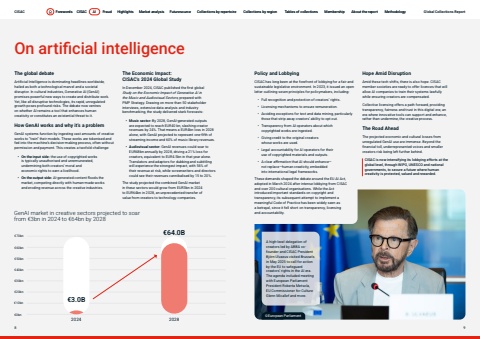
Page titleStandfirstBodyOn artificial intelligenceThe global debateArtificial Intelligence is dominating headlines worldwide, hailed as both a technological marvel and a societal disruptor. In cultural industries, Generative AI (GenAI) promises powerful new ways to create and distribute work. Yet, like all disruptive technologies, its rapid, unregulated growth poses profound risks. The debate now centres on whether AI remains a tool that enhances human creativity or constitutes an existential threat to it.How GenAI works and why it%u2019s a problemGenAI systems function by ingesting vast amounts of creative works to %u201ctrain%u201d their models. These works are tokenised and fed into the machine%u2019s decision-making process, often without permission and payment. This creates a twofold challenge:%u2022 On the input side: the use of copyrighted works is typically unauthorised and unremunerated, undermining both creators%u2019 moral and economic rights to earn a livelihood.%u2022 On the output side: AI-generated content floods the market, competing directly with human-made works and eroding revenue across the creative industries.The Economic Impact: CISAC%u2019s 2024 Global StudyIn December 2024, CISAC published the first global Study on the Economic Impact of Generative AI in the Music and Audiovisual Sectors, prepared with PMP Strategy. Drawing on more than 50 stakeholder interviews, extensive data analysis and industry benchmarking, the study delivered stark forecasts:%u2022 Music sector: By 2028, GenAI-generated outputs are expected to reach EUR40 bn, slashing creator revenues by 24%. That means a EUR4bn loss in 2028 alone, with GenAI projected to represent one-fifth of streaming income and 60% of music library revenues.%u2022 Audiovisual sector: GenAI revenues could soar to EUR48bn annually by 2028, driving a 21% loss for creators, equivalent to EUR4.5bn in that year alone. Translators and adaptors for dubbing and subtitling will experience the strongest impact, with 56% of their revenue at risk, while screenwriters and directors could see their revenues cannibalised by 15 to 20%.The study projected the combined GenAI market in these sectors would grow from EUR3bn in 2024 to EUR64bn in 2028, an unprecedented transfer of value from creators to technology companies.Hope Amid DisruptionAmid these tech shifts, there is also hope. CISAC member societies are ready to offer licences that will allow AI companies to train their systems lawfully while ensuring creators are compensated. Collective licensing offers a path forward, providing transparency, fairness and trust in this digital era; an era where innovative tools can support and enhance, rather than undermine, the creative process.The Road AheadThe projected economic and cultural losses from unregulated GenAI use are immense. Beyond the financial toll, underrepresented voices and smaller creators risk being left further behind. CISAC is now intensifying its lobbying efforts at the global level, through WIPO, UNESCO and national governments, to secure a future where human creativity is protected, valued and rewarded.GenAI market in creative sectors projected to soar from %u20ac3bn in 2024 to %u20ac64bn by 2028Policy and LobbyingCISAC has long been at the forefront of lobbying for a fair and sustainable legislative environment. In 2023, it issued an open letter outlining seven principles for policymakers, including:%u2022 Full recognition and protection of creators%u2019 rights.%u2022 Licensing mechanisms to ensure remuneration.%u2022 Avoiding exceptions for text and data mining, particularly those that strip away creators%u2019 ability to opt out.%u2022 Transparency from AI operators about which copyrighted works are ingested.%u2022 Giving credit to the original creators whose works are used.%u2022 Legal accountability for AI operators for their use of copyrighted materials and outputs.%u2022 A clear affirmation that AI should enhance%u2014not replace%u2014human creativity, embedded into international legal frameworks.These demands shaped the debate around the EU AI Act, adopted in March 2024 after intense lobbying from CISACand over 200 cultural organisations. While the Act introduced important standards on copyright and transparency, its subsequent attempt to implement a meaningful Code of Practice has been widely seen as a betrayal, since it fell short on transparency, licensing and accountability.A high-level delegation of creators led by ABBA cofounder and CISAC President Bj%u00f6rn Ulvaeus visited Brussels in May 2025 to call for action by the EU to safeguard creators%u2019 rights in the AI era. The agenda included meeting with European Parliament President Roberta Metsola, EU Commissioner for Culture Glenn Micallef and more.%u00a9European Parliament%u20ac70bn%u20ac50bn%u20ac30bn%u20ac10bn%u20ac60bn%u20ac40bn%u20ac20bn%u20ac0bn2024 2028%u20ac3.0B%u20ac64.0BCISAC Forewords CISAC AI Fraud Highlights Market analysis Futuresource Collections by repertoire Collections by region Tables of collections Membership About the report Methodology8 9Forewords CISAC AI Fraud Highlights Market analysis Futuresource Collections by repertoire Collections by region Tables of collections Membership About the report Methodology Global Collections Report


