


Page 12 - Demo
P. 12
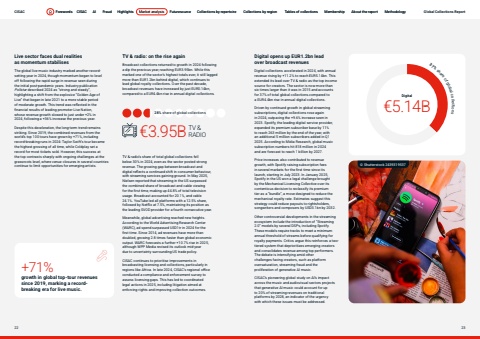
Page titleStandfirstBodyLive sector faces dual realities as momentum stabilisesThe global live music industry marked another recordsetting year in 2024, though momentum began to level off following the rapid surge in revenue seen during the initial post-pandemic years. Industry publication Pollstar described 2024 as %u201cstrong and steady%u201d, highlighting a shift from the explosive %u201cGolden Age of Live%u201d that began in late 2021 to a more stable period of moderate growth. This trend was reflected in the financial results of leading promoter Live Nation, whose revenue growth slowed to just under +2% in 2024, following a +36% increase the previous year.Despite this deceleration, the long-term trend remains striking. Since 2019, the combined revenues from the world%u2019s top 100 tours have grown by +71%, including record-breaking runs in 2024: Taylor Swift%u2019s tour became the highest grossing of all time, while Coldplay set a record for most tickets sold. However, this success at the top contrasts sharply with ongoing challenges at the grassroots level, where venue closures in several countries continue to limit opportunities for emerging artists.TV & radio: on the rise againBroadcast collections returned to growth in 2024 following a dip the previous year, reaching EUR3.95bn. While this marked one of the sector%u2019s highest totals ever, it still lagged more than EUR1.2bn behind digital, which continues to lead global royalty collections. Over the past decade, broadcast revenues have increased by just EUR0.14bn, compared to a EUR4.4bn rise in annual digital collections.Digital opens up EUR1.2bn lead over broadcast revenuesDigital collections accelerated in 2024, with annual revenue rising by +11.2% to reach EUR5.14bn. This extended its lead over TV & radio as the top income source for creators. The sector is now more than six times larger than it was in 2015 and accounts for 37% of total global collections.compared to a EUR4.4bn rise in annual digital collections.Driven by continued growth in global streaming subscriptions, digital collections rose again in 2024, outpacing the +9.6% increase seen in 2023. Spotify, the leading digital service provider, expanded its premium subscriber base by 11% to reach 263 million by the end of the year, with an additional 5 million subscribers added in Q1 2025. According to Midia Research, global music subscription numbers hit 818 million in 2024 and are forecast to reach 1 billion by 2027.Price increases also contributed to revenue growth, with Spotify raising subscription fees in several markets for the first time since its launch, starting in July 2023. In January 2025, Spotify in the US won a legal challenge brought by the Mechanical Licensing Collective over its contentious decision to reclassify its premium tier as a %u201cbundle%u201d, a move designed to reduce the mechanical royalty rate. Estimates suggest this strategy could reduce payouts to rightsholders, songwriters and composers by USD3.1bn by 2032.Other controversial developments in the streaming ecosystem include the introduction of %u201cStreaming 2.0%u201d models by several DSPs, including Spotify. These models require tracks to meet a minimum annual threshold of streams before qualifying for royalty payments. Critics argue this reinforces a twotiered system that deprioritizes emerging creators and consolidates revenue among top performers. The debate is intensifying amid other challenges facing creators, such as platform oversaturation, streaming fraud and the proliferation of generative AI music.CISAC%u2019s pioneering global study on AI%u2019s impact across the music and audiovisual sectors projects that generative AI music could account for up to 20% of streaming revenues on traditional platforms by 2028, an indicator of the urgency with which these issues must be addressed.37% share ofglobal collect oi nsDigital %u20ac5.14B+71%growth in global top-tour revenues since 2019, marking a recordbreaking era for live music.TV & radio%u2019s share of total global collections fell below 30% in 2024, even as the sector posted strong revenue. The growing gap between broadcast and digital reflects a continued shift in consumer behaviour, with streaming services gaining ground. In May 2025, Nielsen reported that streaming in the US surpassed the combined share of broadcast and cable viewing for the first time, making up 44.8% of total television usage. Broadcast accounted for 20.1%, and cable 24.1%. YouTube led all platforms with a 12.5% share, followed by Netflix at 7.5%, maintaining its position as the leading SVOD provider for a fourth consecutive year.Meanwhile, global advertising reached new heights. According to the World Advertising Research Center (WARC), ad spend surpassed USD1tr in 2024 for the first time. Since 2014, ad revenues have more than doubled, growing 2.8 times faster than global economic output. WARC forecasts a further +10.7% rise in 2025, although WPP Media revised its outlook mid-year due to uncertainty surrounding US trade policy.CISAC continues to prioritise improvements in broadcasting licensing and collections, particularly in regions like Africa. In late 2024, CISAC%u2019s regional office conducted a compliance and enforcement survey to assess licensing gaps. This has led to coordinated legal actions in 2025, including litigation aimed at enforcing rights and improving collection outcomes.%u20ac3.95BTV & RADIO28% share of global collections%u00a9 Shutterstock 2439319537CISAC Forewords CISAC AI Fraud Highlights Market analysis Futuresource Collections by repertoire Collections by region Tables of collections Membership About the report Methodology22 23Forewords CISAC AI Fraud Highlights Market analysis Futuresource Collections by repertoire Collections by region Tables of collections Membership About the report Methodology Global Collections Report


