


Page 19 - Demo
P. 19
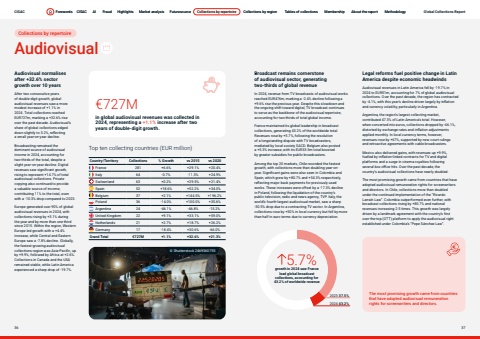
Page titleStandfirstBodyCollections by repertoireAudiovisual normalises after +32.6% sector growth over 10 years After two consecutive years of double-digit growth, global audiovisual revenues saw a more modest increase of +1.1% in 2024. Total collections reached EUR727m, marking a +32.6% rise over the past decade. Audiovisual%u2019s share of global collections edged down slightly to 5.2%, reflecting a small year-on-year decline. Broadcasting remained the dominant source of audiovisual income in 2024, accounting for two-thirds of the total, despite a slight year-on-year decline. Digital revenues saw significant growth, rising to represent +14.7% of total audiovisual collections. Private copying also continued to provide a valuable source of income, contributing 11% to the total, even with a -10.3% drop compared to 2023. Europe generated over 90% of global audiovisual revenues in 2024, with collections rising by +3.1% during the year and by more than one-third since 2015. Within the region, Western Europe led growth with a +4.4% increase, while Central and Eastern Europe saw a -7.8% decline. Globally, the fastest-growing audiovisual collections region was Asia-Pacific, up by +9.9%, followed by Africa at +2.6%. Collections in Canada and the USA remained stable, while Latin America experienced a sharp drop of -19.7%. %u20ac727Min global audiovisual revenues was collected in 2024, representing a +1.1% increase after two years of double-digit growth.Audiovisual%u00a9 Shutterstock 2469360755 Broadcast remains cornerstone of audiovisual sector, generating two-thirds of global revenueIn 2024, revenue from TV broadcasts of audiovisual works reached EUR476m, marking a -2.4% decline following a +9.6% rise the previous year. Despite this slowdown and the ongoing shift toward digital, TV broadcast continues to serve as the backbone of the audiovisual repertoire, accounting for two-thirds of total global income.France maintained its global leadership in broadcast collections, generating 43.2% of the worldwide total. Revenues rose by +5.7%, following the resolution of a longstanding dispute with TV broadcasters, mediated by local society SACD. Belgium also posted a +5.3% increase, with its EUR33.5m total boosted by greater subsidies for public broadcasters.Among the top 20 markets, Chile recorded the fastest growth, with collections more than doubling year-onyear. Significant gains were also seen in Colombia and Spain, which grew by +80.7% and +54.3% respectively, reflecting major back payments for previously used works. These increases were offset by a -17.3% decline in Poland, following the liquidation of the country%u2019s public television, radio and news agency, TVP. Italy, the world%u2019s fourth-largest audiovisual market, saw a sharp -30.5% drop due to a contracting TV sector. In Argentina, collections rose by +50% in local currency but fell by more than half in euro terms due to currency depreciation.Legal reforms fuel positive change in Latin America despite economic headwindsAudiovisual revenues in Latin America fell by -19.7% in 2024 to EUR51m, accounting for 7% of global audiovisual collections. Over the past decade, the region has contracted by -4.1%, with this year%u2019s decline driven largely by inflation and currency volatility, particularly in Argentina.Argentina, the region%u2019s largest collecting market, contributed 47.3% of Latin America%u2019s total. However, when converted into euros, collections dropped by -46.1%, distorted by exchange rates and inflation adjustments applied monthly. In local currency terms, however, revenues rose by +67%, supported by new court rulings and retroactive agreements with cable broadcasters.Mexico also delivered gains, with revenues up +9.9%, fuelled by inflation-linked contracts for TV and digital platforms and a surge in cinema royalties following several box office hits. Over the past decade, the country%u2019s audiovisual collections have nearly doubled.The most promising growth came from countries that have adopted audiovisual remuneration rights for screenwriters and directors. In Chile, collections more than doubled under the continued implementation of the %u201cRicardo Larra%u00edn Law%u201d. Colombia outperformed even further, with broadcast collections rising by +80.7% and national revenues increasing 2.5 times. This growth was largely driven by a landmark agreement with the country%u2019s first over-the-top (OTT) platform to apply the audiovisual right established under Colombia%u2019s %u201cPepe S%u00e1nchez Law%u201d.2023 37.5%2024 43.2%5.7%growth in 2024 saw France lead global broadcast collections, accounting for 43.2% of worldwide revenueThe most promising growth came from countries that have adopted audiovisual remuneration rights for screenwriters and directors.Country/Territory Collections % Growth vs 2015 vs 2020France 281 +6.6% +29.1% +20.4%Italy 64 -0.7% -11.3% +24.9%Switzerland 63 +0.2% +29.5% +21.4%Spain 52 +18.6% +52.2% +34.0%Belgium 37 +2.1% +144.5% +196.2%Poland 36 -14.0% +100.0% +35.6%Argentina 24 -46.1% -46.8% -15.2%United Kingdom 22 +9.1% +33.1% +59.0%Netherlands 21 +2.7% +18.7% +26.2%Germany 17 -18.4% +30.6% -66.0%Grand Total %u20ac727M +1.1% +32.6% +21.3%Top ten collecting countries (EUR million) CISAC Forewords CISAC AI Fraud Highlights Market analysis Futuresource Collections by repertoire Collections by region Tables of collections Membership About the report Methodology36 37Forewords CISAC AI Fraud Highlights Market analysis Futuresource Collections by repertoire Collections by region Tables of collections Membership About the report Methodology Global Collections Report


