


Page 24 - Demo
P. 24
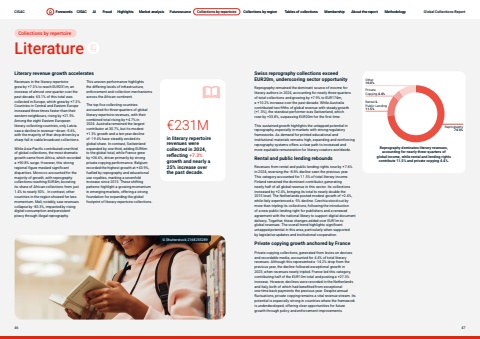
Page titleStandfirstBodyCollections by repertoireLiterature%u20ac231Min literary repertoire revenues were collected in 2024, reflecting +7.3%growth and nearly a 25% increase over the past decade.Literary revenue growth accelerates Revenues in the literary repertoire grew by +7.3% to reach EUR231m, an increase of almost one-quarter over the past decade. 63.1% of this total was collected in Europe, which grew by +7.3%. Countries in Central and Eastern Europe increased three times faster than their western neighbours, rising by +21.5%. Among the eight Eastern European literary collecting countries, only Latvia saw a decline in revenue%u2014down -5.6%, with the majority of that drop driven by a sharp fall in cable broadcast collections. While Asia-Pacific contributed one-third of global collections, the most dramatic growth came from Africa, which recorded a +90.8% surge. However, this strong regional figure masked significant disparities. Morocco accounted for the majority of growth, with reprography collections reaching EUR4m, boosting its share of African collections from just 1.4% to nearly 50% . In contrast, other countries in the region showed far less momentum. Mali, notably, saw revenues collapse by -83.3%, impacted by rising digital consumption and persistent piracy through illegal reprography.This uneven performance highlights the differing levels of infrastructure, enforcement and collection mechanisms across the African continent. The top five collecting countries accounted for three-quarters of global literary repertoire revenues, with their combined total rising by +4.7% in 2024. Australia remained the largest contributor at 30.7%, but its modest +1.3% growth and a ten-year decline of -19.4% have steadily eroded its global share. In contrast, Switzerland expanded by one-third, adding EUR6m to the global total, while France grew by +26.6%, driven primarily by strong private copying performance. Belgium recorded the highest growth at +43.9%, fuelled by reprography and educational use royalties, marking a sevenfold increase since 2015. These shifting patterns highlight a growing momentum in emerging markets, offering a strong foundation for expanding the global footprint of literary repertoire collections. %u00a9 Shutterstock 2168255289 Swiss reprography collections exceed EUR20m, underscoring sector opportunity Reprography remained the dominant source of income for literary authors in 2024, accounting for nearly three-quarters of total collections and growing by +7.9% to EUR174m, a +10.2% increase over the past decade. While Australia contributed two-fifths of global revenue with steady growth (+1.3%), the standout performer was Switzerland, which rose by +33.8%, surpassing EUR20m for the first time. This sustained growth highlights the untapped potential in reprography, especially in markets with strong regulatory frameworks. As demand for printed educational and institutional materials remains high, expanding and reinforcing reprography systems offers a clear path to increased and more equitable remuneration for literary creators worldwide. Rental and public lending reboundsRevenues from rental and public lending rights rose by +7.6% in 2024, reversing the -8.8% decline seen the previous year. This category accounted for 11.5% of total literary income. Finland remained the dominant contributor, generating nearly half of all global revenue in this sector. Its collections increased by +2.4%, bringing its total to nearly double the 2015 level. The Netherlands posted modest growth of +2.4%, while Italy experienced a -5% decline. Czechia stood out by more than tripling its collections, following the introduction of a new public lending right for publishers and a renewed agreement with the national library to support digital document delivery. Together, these changes added over EUR1m to global revenues. The overall trend highlights significant untapped potential in this area, particularly when supported by legislative updates and institutional cooperation.Private copying growth anchored by FrancePrivate copying collections, generated from levies on devices and recordable media, accounted for 4.4% of total literary revenues. Although this represented a -14.2% drop from the previous year, the decline followed exceptional growth in 2023, when revenues nearly tripled. France led this category, contributing half of the EUR10m total and posting a +27.3% increase. However, declines were recorded in the Netherlands and Italy, both of which had benefited from exceptional one-time back payments the previous year. Despite annual fluctuations, private copying remains a vital revenue stream. Its potential is especially strong in countries where the framework is underdeveloped, offering clear opportunities for future growth through policy and enforcement improvements.Reprography 74.0%Rental & Public Lending 11.5%Private Copying 4.4%Other10.0%Reprography dominates literary revenues, accounting for nearly three-quarters of global income, while rental and lending rights contribute 11.5% and private copying 4.4%.CISAC Forewords CISAC AI Fraud Highlights Market analysis Futuresource Collections by repertoire Collections by region Tables of collections Membership About the report Methodology46 47Forewords CISAC AI Fraud Highlights Market analysis Futuresource Collections by repertoire Collections by region Tables of collections Membership About the report Methodology Global Collections Report


